Proliferation / Differentiation / Cell Cycle
总结自;
- Wikipedia - Cell cycle
- Wikipedia - 细胞周期
- 百度百科 - 细胞周期
- Wikipedia - Mitosis
- Wikipedia - 有丝分裂
- The Cell: A Molecular Approach. 2nd edition.
- Genetic Home Reference - Handbook
Proliferation (增殖) 与 Cell Cycle 的关系
cell cycle 是增殖的 mechanism,或者说;细胞增殖 $\iff$ cell is running cell cycle repeatedly ($G_1 \Rightarrow S \Rightarrow G_2 \Rightarrow M$).
Differentiation (分化) 与 Cell Cycle 的关系
对分化,我们要区分 “分化的 mechanism” 和 “分化的 process”.
这里我们先讨论 “分化的 process”. 我们考虑一个简单的情况:假设我们从 cell type $T_1$ 一路分化到了 $T_n$。那么这整个分化的过程就可以视为一个 chain $T_1 \rightarrow T_2 \rightarrow \cdots \rightarrow T_n$. 扩展一下有:
- 如果我们考虑从受精卵 (zygote, 唯一真正的 totipotent cell, 即全能 stem cell) 到所有人体的 cell types,这整个分化过程应该是一个类似 tree 的 graph
- root 是 zygote $Z$
- 每个 leaf 都是 terminally differentiated cell type $T \in \mathbf{T}_{\text{TD}}$
- 所谓 terminally differentiated 就是指无法再分化的 cell
- 但如果我们只想研究某单个 $T_k$ 的分化路径 (也不一定要从 zygote 开始),那么这个局部的 path $T_i \rightarrow \dots \rightarrow T_k$ 我们也称为一个 (局部的) 分化过程
- reversible differentiation 即是允许在 differentiation 的 graph 或者 path 中存在 cycle
- termimal differentiation 即是 destination 为 $T \in \mathbf{T}_{\text{TD}}$ 的 differentiation
“分化的 process” 与 cell cycle 不是一个抽象层次的东西,所以我们不会放到一起讨论。
“分化的 mechanism” 与 cell cycle 的 phases 有关系,但严格来说,”分化的 mechanism” 与 cell cycle 整体并没有关系,因为分化是 cell 退出 cell cycle 之后进行的。
与 “分化的 mechanism” 密切相关的是 $G_1$,它其实是一个决策点,cell 在此时会根据各种条件选择:
- 不分化 (维持当前 cell type $T_i$),只增殖 (进入 $S$)
- 不分化,不增殖 (退出 cell cycle,进入 $G_0$)
- 某些细胞也可能从 $G_0$ 启动分化
- 只分化 (沿 edge $T_i \rightarrow T_j$ 进行),不增殖 (一般情况下,分化进行的时候无法增殖)
- 注意 cell 在 $G_1$ 会决断这是不是一个 termimal differentiation,导致 “分化的 mechanism” 略有不同 (主要体现在 chromatin locking)
Overview of Cell Cycle
以下这个 Cell Cycle 只针对 somatic cells. somatic cells 都是有丝分裂 (Mitosis),而 germ cells 是减数分裂 (Meiosis),不在本文的讨论范围内。
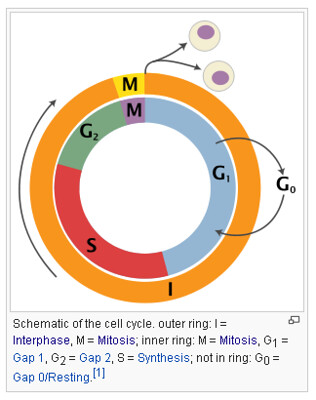
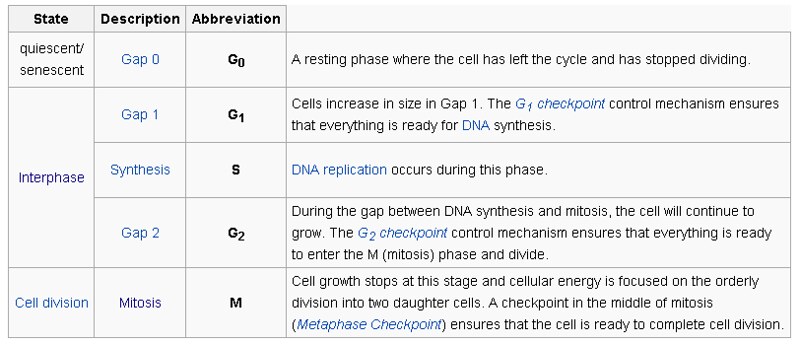
Cell Cycle (细胞周期)
- Interphase (分裂间期)
- $G_1$ phase (Gap 1 | DNA 合成前期)
- $S$ phase (Synthesis | DNA 合成期)
- $G_2$ phase (Gap 2 | DNA 合成后期)
- Mitosis $M$ (分裂期 | 有丝分裂)
- Prophase (前期)
- Prometaphase (前中期)
- Metaphase (中期)
- Anaphase (后期)
- Telophase (末期)
一个完整的 cell cycle 指 $G_1 \Rightarrow S \Rightarrow G_2 \Rightarrow M$ 这 4 stages.
[!info]
The word post-mitotic is sometimes used to refer to both quiescent and senescent cells. 不一定就是指 $G_0$。
$G_1$ phase
$G_1$ is defined as the phase from the end of previous $M$ until the beginning of $S$.
In this phase, the cell increases its supply of proteins, increases the number of organelles (such as mitochondria, ribosomes), and grows in size.
$S$ phase
会进行如下工作:
- chromosome 开始复制
- 复制完成后,两条新生的 chromatids 通过 centromere 连接在一起,此时称为 sister chromatids
因为 every chromatid has a short p-arm (“p” for “petit”) and a long q-arm (“q” for “queue”),所以这时染色体在显微镜下看起来像 “X” 形:
*****
*   *
* p *
* | *
* | *
* | *  <= chr18^p before S phase
* | *
* | *
* q *
*   *
*****
******************
*                *
* p       p_copy *
* \       /      *
*  ==[x]==       *
* /       \      *  <= chr18^p after S phase
* |       |      *
* |       |      *
* q       q_copy *
*                *
******************
$G_2$ phase
$G_2$ phase occurs after DNA replication and is a period of protein synthesis and rapid cell growth to prepare the cell for mitosis. During this phase microtubules begin to reorganize to form a spindle (preprophase). Before proceeding to $M$, cells must be checked at the $G_2$ checkpoint for any DNA damage within the chromosomes. The $G_2$ checkpoint is mainly regulated by the tumor protein
p53. If the DNA is damaged,p53will either repair the DNA or trigger the apoptosis of the cell. Ifp53is dysfunctional or mutated, cells with damaged DNA may continue through the cell cycle, leading to the development of cancer.
[!info] apoptosis
apoptosis 指细胞 breaks apart and gets recycled by the white blood cell “macrophage” 的过程
[!info] cancer
Cancer results from a disruption of the normal regulation of the cell cycle. When the cycle proceeds without control, cells can divide without order and accumulate genetic defects that can lead to a cancerous tumor.
$M$ in general
- 所有的 X-shaped chromosomes 排列在细胞中央的赤道板上
- 纺锤体 (spindle) 伸出纺锤丝,attach 到 centromere
- centromere 分裂,sister chromatids 被纺锤丝拉向细胞两极
- 生成新的细胞膜、细胞质一分为二,形成两个细胞
The division of somatic cells and single celled organisms results in the production of two identical daughter cells.
留下评论